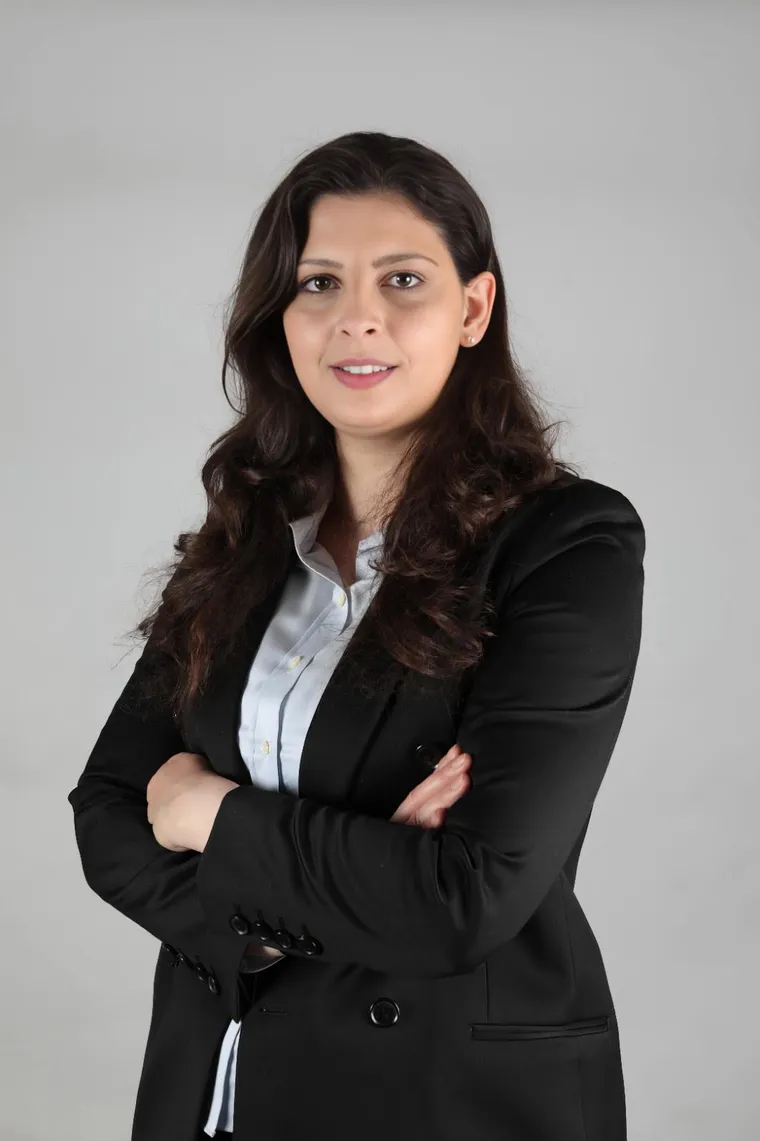
Portrait of Imen Chaanbi

Geopolitics of Africa and the Middle East

Imen Chaanbi

Expert in geopolitics, economic intelligence and strategic monitoring

  • Geopolitics
  • Strategic intelligence
  • Economic intelligence
  • Foresight
  • Africa
  • Middle East
Short address strategikia.com/chaanbi
  • P33
    civilian auditor, École de guerre
  • IHEDN
    auditor, 64th session (economic intelligence)
  • CR451
    member, École de Guerre Économique
01

Biography

Ms Imen CHAANBI is an expert in geopolitics, economic intelligence and strategic monitoring at the consultancies 5WE Consulting and StrategikIA. She graduated from Université Paris 1 Panthéon-Sorbonne in the law of the Arab world and in international business law, and also holds a degree in psychocriminology.

Specialising in geopolitics and geoeconomics, she works on security issues, the analysis of power relations and influence strategies, and risk anticipation. She takes part in strategic research programmes and has recognised expertise on Africa and the Middle East.

A civilian auditor of the École de guerre (P33) and of France’s Institute for Higher National Defence Studies, IHEDN (64th session, economic intelligence), she is a member of CR451 at the École de Guerre Économique and of the panel of experts of the Académie de l’intelligence économique.

She also works as a speaker and trainer for diplomats, senior executives, academic institutions and students.

02

Interview

Strategikia asks

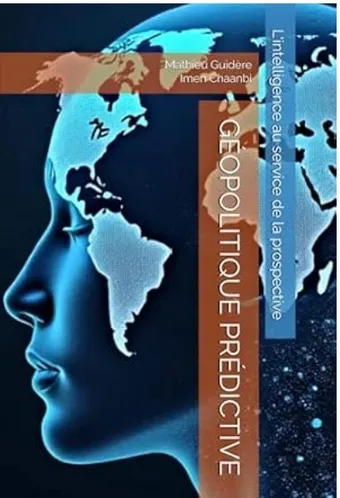
With Mathieu Guidère, Imen Chaanbi co-wrote Géopolitique prédictive: l’intelligence au service de la prospective (Predictive Geopolitics: Intelligence in the Service of Foresight, Strategik.IA, 2025). The book combines artificial intelligence and strategic analysis to anticipate shifts across an arc stretching from the Maghreb and the Mashreq to the Sahel and the Gulf, and on to Afghanistan, Pakistan, India and China. Strategikia asked her about the method, its limits and what it changes for decision-makers.

  1. How did this book, co-written with Mathieu Guidère, come about?

    From the meeting of two approaches. Mathieu Guidère founded predictive linguistics and has long worked on detecting signals in language. For my part, I support companies and institutions on the ground in Africa and the Middle East, with a very practical need: to anticipate rather than react.

    We wanted a book that would be useful both to decision-makers, who need clarity, and to analysts, who need operational tools.

  2. Why did you choose this arc from the Maghreb to China?

    Because it is a space where tensions, transitions and power projection are closely intertwined. It has energy rivalries around the Gulf, shifting identities and the erosion of state mediation in the Sahel.

    It is a hard region to predict, and that is precisely what makes it valuable for foresight: it produces an abundance of the weak signals that herald tipping points.

  3. In practice, how does artificial intelligence fit into your method?

    At three levels. First, a highly diverse database: economic series, climate data, migration flows, religious and political discourse, social media, videos and testimonies. Next, algorithmic processing that cross-references these data and brings correlations to light. Finally, and this is essential, human analysis that places those correlations within a strategic framework.

    The result takes the form of layered country profiles, covering security, economic, identity and environmental factors, regularly updated and designed to spot tipping points rather than describe a static situation.

  4. Can you give an example of a weak signal?

    Southern Algeria, on the border with Mali and Niger, is a good example. On its own, no single indicator raises an alarm: advancing desertification, changes in certain religious discourse, the decline of social rituals, shifts in remittances. It is their combination that becomes significant.

    Likewise, in the Sahel, social unravelling was perceptible several months before the collapses became visible. That is what we call cascading conflicts: a local shock that spreads to neighbouring areas.

  5. So can AI predict crises?

    No, and that needs to be said clearly. AI does not predict on its own: it makes emerging patterns readable. It provides trends and probabilities, never control over reality.

    Every prediction rests on choices of framing and variables, so it is never neutral. Hence the need for transparency: publishing the parameters, margins of error, sources and limits, and cross-checking the results against field expertise and local sources.

  6. Is France lagging behind in this field?

    Foresight there too often remains theoretical and removed from operational needs, while countries such as Russia, China, the United Arab Emirates and India are investing heavily in these capabilities.

    Our book argues for a French culture of anticipation, one that accepts uncertainty as a given and builds on France’s own analytical traditions rather than importing foreign models.

  7. You advocate “strategic optimism”. What is it based on?

    The classic Great Game, with stable players and clearly defined spheres of influence, has crumbled. Competition has become asymmetric, involving states, companies, non-state groups and platforms. The energy and technology transitions are opening up room for manoeuvre for players who have long been sidelined, particularly in the Global South.

    But anticipation has two faces. It can help us break out of reactive thinking, or it can fuel a race to predict and mutual suspicion. That is why we argue for shared anticipation, used to regulate rather than to justify unilateral decisions.

03

Publications

Géopolitique prédictive, Strategik.IA
Book

Géopolitique prédictive

L’intelligence au service de la prospective
with Mathieu Guidère · Strategik.IA · 2025

A forward-looking analysis of geopolitical shifts across the arc from the Maghreb and the Mashreq to the Sahel and the Gulf, and on to Afghanistan, Pakistan, India and China. Modular country profiles, informed by algorithmic modelling and weak-signal detection, designed to identify tipping points.


Article· Published in Le Diplomate

Le Grand Entretien du Diplomate : Géopolitique prédictive

July 19, 2025

Interview with Roland Lombardi on the book’s method, weak signals, cascading conflicts and the place of foresight in France.

Article· Published in Cercle K2

Géopolitique des violences faites aux femmes : corps dominés, émotions gouvernées

with Isabelle Dréan-Rivette · January 27, 2026
Article· Published in Cercle K2

Le Sahel post-France

July 3, 2025

French troops withdrawn, new players arriving, an open break by the Alliance of Sahel States. The author analyses the end of an era and the conditions for regional stability.

Article· Published in Cercle K2

Diplomatie française en Afrique : repenser l’alliance pour un avenir partagé

July 21, 2025

04 · Video

Egypt, a geostrategic crossroads between Africa and the Middle East

Talk at the “Security and Peace in Africa and the Middle East” conference.

Institut Afrika · April 30, 2025

More talks

What future for the Atlantic?

Académie de géopolitique de Paris · May 14, 2025

What future for Afghanistan?

Académie de géopolitique de Paris · April 23, 2025